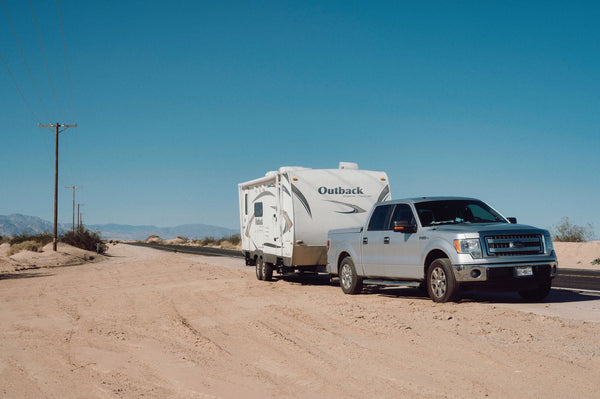

Every year, thousands of RV and travel trailer owners hit the road for spring and summer adventures — and every year, a good chunk of them end up on the shoulder with a blown tire, a failed brake light, or a loose hitch. The frustrating part? Almost all of these breakdowns are preventable with a solid pre-trip inspection.
Whether you're pulling a 16-foot teardrop or a 35-foot fifth wheel, taking 30 minutes to walk through a systematic checklist before each trip can save you hours of headaches, hundreds in emergency repairs, and potentially your life. Here's the complete inspection guide we recommend.
Tires: The Most Critical Check You Can Make
Trailer tires fail more often than you'd expect — and when they do at highway speeds, the damage to your fender wells, wiring, and even frame can be catastrophic. Trailer tires live a harder life than car tires: they carry heavy loads, sit in the sun for months between trips, and don't benefit from the steering and suspension dynamics that help car tires wear evenly.
Tire pressure: This is the single most important item on your checklist. Check every tire (including the spare) with a reliable gauge — not the gas station stick gauge that hasn't been calibrated since 2014. Underinflated trailer tires generate excessive heat, which is the leading cause of blowouts. Overinflation reduces your contact patch and makes handling unpredictable.
Check the sidewall for the maximum cold inflation pressure, and check your trailer's door placard for the recommended pressure. Always measure when tires are cold (before driving or sitting in direct sun).

A quality tire pressure gauge like the JACO ElitePro™ Tire Pressure Gauge gives you accurate, repeatable readings every time. Pencil gauges and cheap digitals can be off by 5+ PSI — which on a trailer tire rated at 50 PSI is a 10% error that matters.
Tread depth and condition: Look for uneven wear patterns (often a sign of overloading or alignment issues), cracks in the sidewall, bulges, or embedded objects. Trailer tires should be replaced every 5-6 years regardless of tread depth, as the rubber compounds degrade from UV exposure and ozone.
Lug nuts: Grab a torque wrench and verify every lug nut is at spec. Trailer wheel studs are notorious for loosening, especially in the first 50-100 miles after a tire change or rotation. Re-torque after your first stop on every trip.
Hitch and Coupler: Your Primary Connection
The hitch system is the only thing keeping your trailer attached to your tow vehicle, so it deserves more than a casual glance. Work through these checks methodically:
- Coupler: Is it fully seated on the ball? Is the latch closed and locked? Tug upward on the coupler — it should not separate from the ball.
- Safety chains: Crossed under the coupler in an X pattern, with enough slack for turns but not so much they drag on the ground. Hooks should face inward (away from the road) so they can't bounce off.
- Breakaway cable: Connected to the tow vehicle frame (not the hitch) and routed so it won't snag during turns.
- Ball size: Confirm your hitch ball matches your coupler size. A 2" ball in a 2-5/16" coupler is a recipe for separation.
- Weight distribution: If you run a WD hitch, verify the spring bars are properly tensioned and the front of the tow vehicle isn't riding high.
Lights and Electrical
Burned-out trailer lights are one of the most common (and most ticketed) issues on the road. Have someone stand behind the trailer while you cycle through every function:
- Brake lights: Both sides, plus the center high-mount if equipped
- Turn signals: Left and right, front and rear
- Running lights: All marker lights and clearance lights along the sides and top
- Reverse lights: If equipped
- License plate light: Easy to forget, easy to get pulled over for
While you're at it, inspect the wiring harness and 7-pin (or 4-pin) connector for corrosion, bent pins, and frayed wires. A little dielectric grease on the connector goes a long way toward preventing intermittent electrical gremlins mid-trip.
Brakes: Stopping Power You Can Trust
Trailer brakes don't get the attention they deserve — until that mountain descent where your tow vehicle's brakes start fading and you realize your trailer brakes are barely working.
Electric brakes: Test your brake controller before leaving. Most controllers have a manual activation button — use it in the driveway at low speed and confirm you feel the trailer braking. Check the breakaway switch by pulling the pin and verifying the brakes lock up.
Surge brakes: Inspect the master cylinder fluid level and the actuator for damage. The slide mechanism on the coupler should move freely.
Brake pads/shoes: If you can access the brakes without pulling the drum, check for wear. Most trailer brakes should be inspected or replaced every 12,000 miles or annually.
Brake fluid/grease: Ensure wheel bearings are properly greased. Bearing failure is a leading cause of trailer wheel separation — and it almost always starts with dried-out grease and a seized bearing.
Cargo and Load Security
How you load your trailer matters as much as what you load it with. Improper weight distribution is behind most trailer sway incidents, and loose cargo inside can shift your center of gravity mid-turn.
Weight distribution: Aim for 60% of your cargo weight in the front half of the trailer (ahead of the axle). Tongue weight should be 10-15% of your total loaded trailer weight. Too little tongue weight causes dangerous sway; too much overloads your tow vehicle's rear axle.
Securing cargo: Everything inside the trailer needs to be strapped, braced, or secured — no exceptions. Heavy items go low and centered. Use quality tie-down straps rated for the weight you're securing.

The JACO Heavy Duty Ratchet Tie Down Straps are AAR-certified with 5,208 lbs break strength and include soft loops to protect your cargo from strap damage. They're built for exactly this kind of work — securing gear inside trailers, lashing down ATVs, and keeping heavy loads locked in place over rough roads. For more on cargo securing techniques, check out our recent guide on cargo management for pickup trucks and SUVs.
Exterior cargo: Roof racks, bike carriers, and kayak mounts should all be double-checked for security. Wind resistance at highway speeds puts enormous stress on external mounting points.
Systems Check: Water, Propane, and Slide-Outs
If you're towing a travel trailer or fifth wheel with living quarters, these systems need attention before you leave:
- Fresh water tank: Fill it if you're heading somewhere without hookups. Check for leaks at the fill port, pump, and connections.
- Water heater: Drain and flush if it's been sitting. Check the anode rod condition.
- Propane: Verify tank levels and check all connections with soapy water (bubbles = leak). Make sure the regulator is functioning and not expired.
- Slide-outs: Extend and retract each slide before leaving. Listen for grinding or binding. Check the seals for cracks or gaps. Lubricate the mechanism per manufacturer specs.
- Awning: Ensure it retracts fully and the hardware isn't corroded or bent.
Keep an Emergency Kit Ready
Even with a thorough pre-trip inspection, things happen on the road. Your trailer emergency kit should include:
- Portable air compressor (the JACO TrailPro™ Heavy Duty Portable Air Compressor delivers 3.5 CFM and handles trailer tires with ease)
- Tire pressure gauge
- Lug wrench that fits your trailer's lug nuts (often a different size than your tow vehicle)
- Torque wrench
- Spare trailer tire, properly inflated
- Jack rated for your trailer's weight
- Wheel chocks
- Basic tool kit (wrenches, screwdrivers, pliers, electrical tape, wire connectors)
- Spare fuses for lights and brake controller
- Bearing grease and spare bearings (for longer trips)

Build the Habit
The best pre-trip inspection is the one you actually do. Print this checklist, laminate it, and hang it in your garage or tow vehicle. Run through it every single time — not just on the first trip of the season, but before every departure. The items that fail mid-trip are almost always the ones that could have been caught in a 30-minute walk-around.
Your trailer is only as safe as the attention you give it before you leave. Make the inspection a habit, keep your equipment maintained, and you'll spend your weekends at the campsite instead of on the side of the highway.