
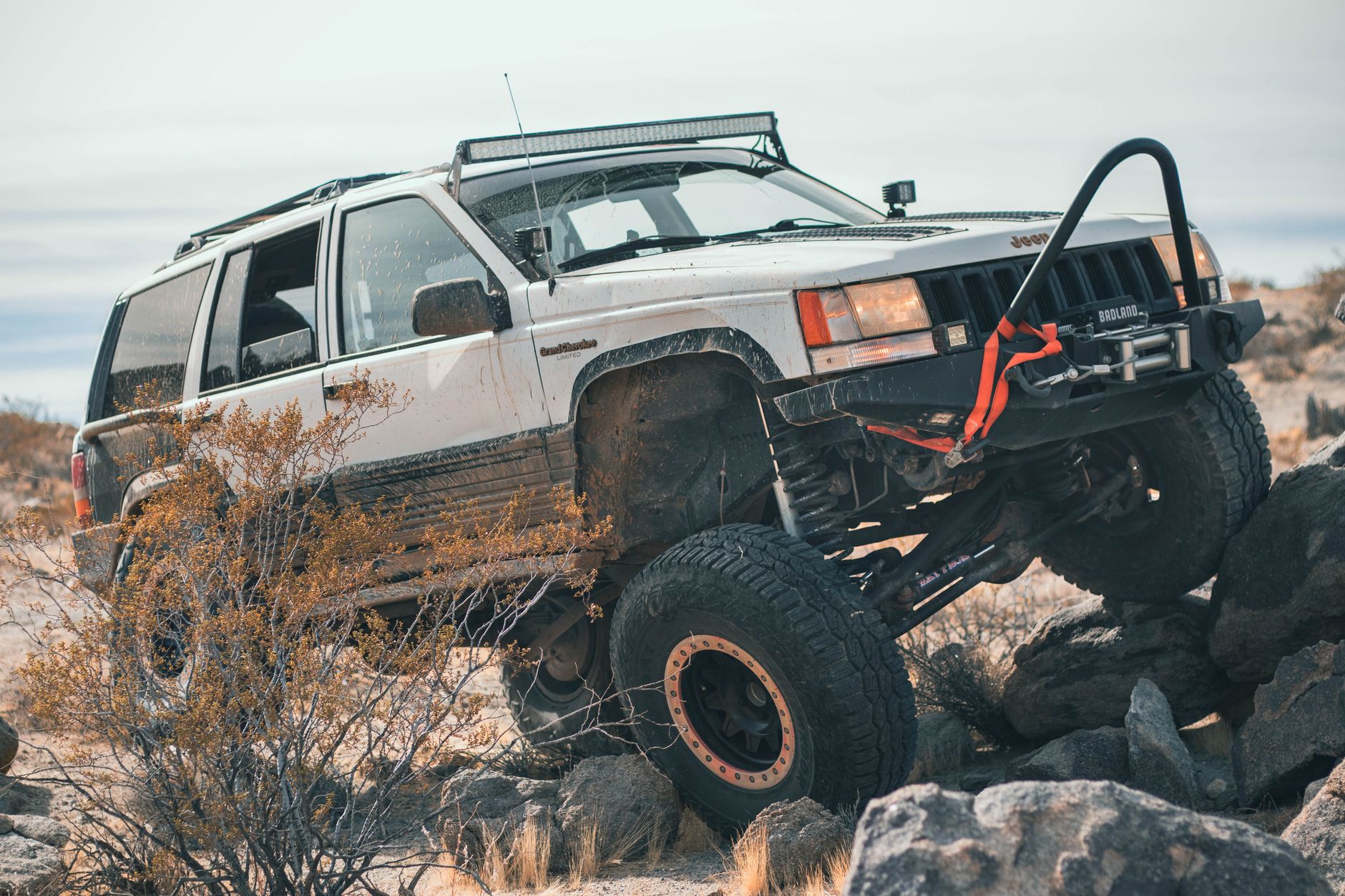
You're crawling up a rocky ledge, the trail gets steep, and suddenly one tire lifts off the ground and starts spinning uselessly in the air while the truck stops dead. Sound familiar? That frustrating moment has a name — it's an open differential doing exactly what it was designed to do, and it's the single biggest reason capable-looking rigs get stuck on terrain they should walk right over.
Understanding how your differential works (and whether you need a locker) is one of the most important pieces of off-road knowledge you can have. Get it right and you'll climb obstacles that leave other drivers winching. Get it wrong and you'll be spending money on gear that doesn't fix your actual problem. Here's the plain-English breakdown of open diffs, limited-slip diffs, and lockers — and how to figure out which one belongs under your rig.
What a Differential Actually Does
Before we talk about locking anything, you need to understand why differentials exist in the first place. When your vehicle turns a corner, the outside wheel travels a longer path than the inside wheel. If both wheels were locked together on a solid axle, one would have to skip and chirp across the pavement to make up the difference. That binding wrecks tires, stresses driveline parts, and makes tight turns miserable.
The differential solves this by letting the two wheels on an axle spin at different speeds while still delivering power to both. It's an elegant piece of engineering that makes everyday driving smooth. The problem is that the standard "open" version has a major weakness the moment you leave the pavement.
Open Differential: Smooth on Pavement, Useless When a Wheel Lifts
An open differential is what comes standard in the vast majority of cars and trucks. It sends power along the path of least resistance — which is great until that path becomes a problem.
Here's the catch: an open diff always sends equal torque to both wheels, but it sends more speed to the wheel with the least traction. So when one tire lifts off the ground or hits ice, mud, or loose gravel, that wheel spins freely and the wheel with grip gets almost nothing. You end up with one tire roasting in the air and a truck that won't move.
On the street, you'll basically never notice. Off-road, on uneven terrain where wheels regularly leave the ground or lose grip, an open differential is the thing standing between you and the top of the obstacle.

Limited-Slip Differential (LSD): The Middle Ground
A limited-slip differential is the factory upgrade that tries to fix the open diff's biggest flaw without the commitment of a full locker. Instead of letting one wheel spin freely, an LSD uses clutches, gears, or a viscous coupling to automatically transfer some power to the wheel that still has grip.
There are a few flavors worth knowing:
- Clutch-type (mechanical): Uses spring-loaded clutch packs to bias torque to the slower-spinning wheel. Responsive and strong, but the clutches wear over time.
- Helical/gear-type (Torsen-style): Uses worm gears to send torque proportionally. Smooth, durable, and maintenance-free — but it needs at least some traction at both wheels to work, so a fully lifted tire still defeats it.
- Viscous: Uses a fluid-filled coupling. Common in AWD crossovers, the weakest of the three for serious off-road use.
An LSD is a fantastic all-rounder. It dramatically improves traction in snow, rain, sand, and moderate trails without any driver input, and it stays civil on the highway. For overlanders and weekend trail drivers who aren't tackling hardcore rock obstacles, a quality limited-slip is often all you need.
Locking Differential: Maximum Traction When It Counts
A locking differential is the heavy hitter. When engaged, a locker mechanically ties both wheels on the axle together so they spin at exactly the same speed — meaning both tires get full power regardless of what one of them is doing. Even with a wheel completely in the air, the tire on the ground keeps pulling.
This is the setup that conquers serious obstacles: rock crawling, deep ruts, steep articulated climbs, and anywhere a wheel is going to lift. Lockers come in two main types:
- Selectable lockers: You flip a switch (air, electric, or cable-actuated) to lock and unlock on demand. Open diff behavior on the street, full lock on the trail — the best of both worlds. Brands like ARB Air Lockers and the Eaton ELocker are the go-to choices.
- Automatic lockers: These engage and disengage on their own based on wheel loading. No switch needed, but they can be noisy, cause occasional handling quirks on pavement, and make clunking sounds during tight turns.
The tradeoff with a locked axle is that it can't differentiate, so you only engage it when you need it — typically in low-range, low-speed situations. Leave a locker engaged on dry pavement and you'll get tire chirp, harsh turning, and unnecessary driveline stress, exactly the problems differentials were invented to prevent.

Open vs. Limited-Slip vs. Locker: Which Do You Need?
The right choice comes down to honestly assessing where you actually drive. Here's the quick decision guide:
- Mostly pavement, occasional dirt road or snow: A factory open diff or a limited-slip is plenty. Don't overbuild.
- Overlanding, forest roads, sand, moderate trails: A limited-slip differential is the sweet spot — automatic, civil, and a huge improvement over open.
- Rock crawling, technical trails, frequent wheel lift, competition: A selectable locker (or two — front and rear) is the answer. Nothing else matches the traction.
- Budget hardcore on a dedicated trail rig: An automatic locker in the rear is a cost-effective way to get serious capability.
A common and smart setup on a built rig is a selectable locker in the rear and a limited-slip or selectable locker up front. Many drivers find that a rear locker alone transforms what their vehicle can do.
Traction Isn't Just About Lockers
Here's the part a lot of people miss: a locker only helps once you've maximized the grip your tires can deliver, and tire pressure is the cheapest, most effective traction tool you own. Airing down expands your tire's contact patch, lets the tread conform to rocks and ruts, and dramatically improves grip on sand, slickrock, and loose surfaces — often the difference between needing a locker and not.
The catch is that airing down by guesswork is slow and imprecise. A dedicated deflator lets you drop all four tires to an exact pressure in seconds, so you spend less time at the trailhead and more time driving. Our Lightning™ RX4 Digital Tire Deflator reads pressure in real time as it rapidly dumps air, so you hit your target without overshooting and re-inflating.

Once you're through the obstacle, you'll want to air back up before hitting the highway, so a reliable portable air compressor rounds out the kit. And no matter how good your traction setup is, proper recovery gear is non-negotiable for the day the trail wins anyway.
The Bottom Line
Differentials are the unsung hero of off-road capability. An open diff keeps your daily driver smooth but quits the moment a wheel lifts. A limited-slip splits the difference, adding real traction with zero driver effort — perfect for overlanding and moderate trails. A locker delivers maximum, unstoppable grip for the gnarly stuff, as long as you remember to unlock it when you're back on the street.
Match the differential to where you actually drive, air down to get the most from your tires, and you'll spend a lot more time climbing and a lot less time stuck. Explore JACO's full lineup of 4x4 and off-road accessories to dial in your rig for whatever the trail throws at it.