

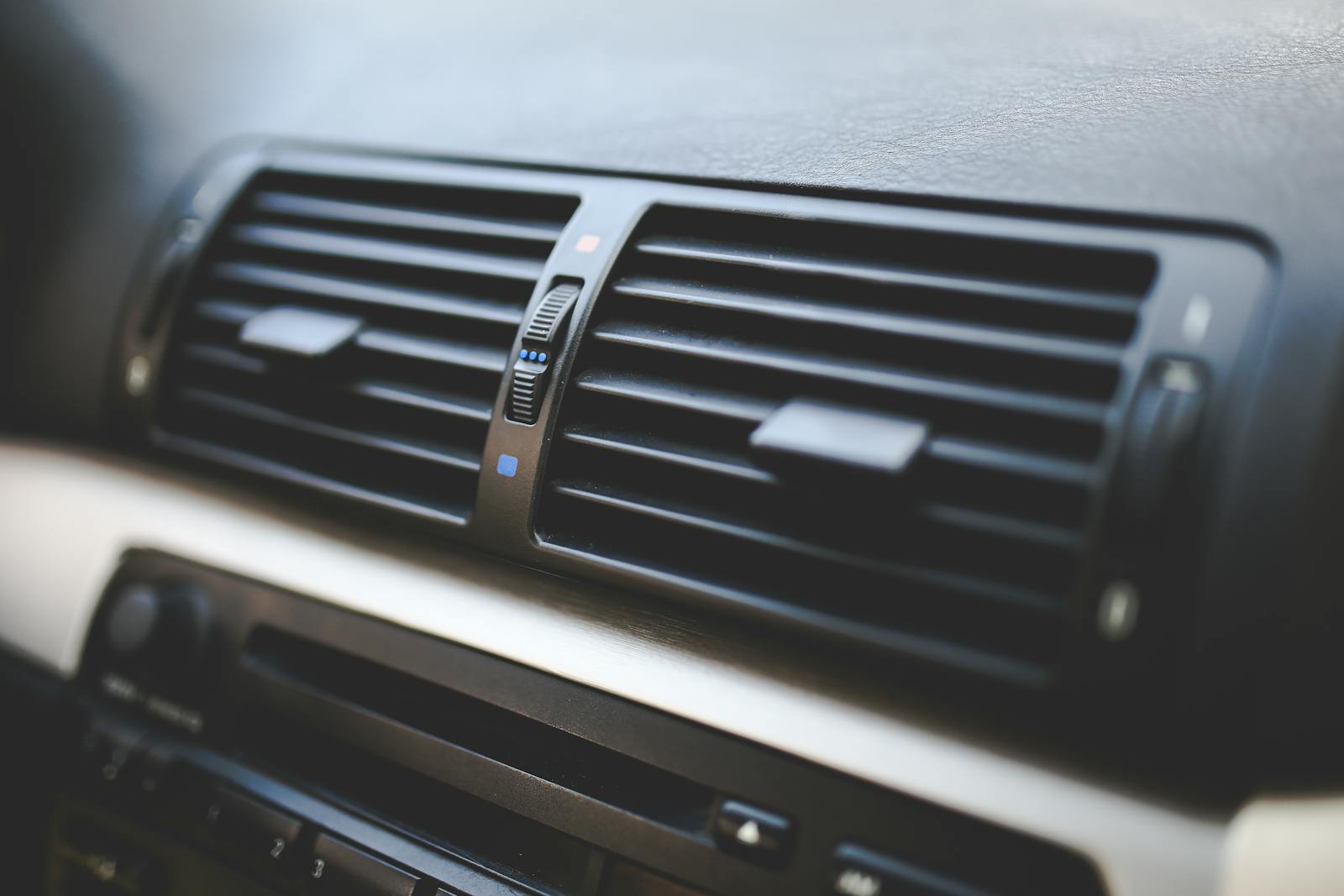
It's the first 90-degree day of the year. You get in, twist the dial to MAX COOL, and… lukewarm air drifts out of the vents. Maybe it's almost cold. Maybe it cools at highway speeds and quits at a stoplight. Maybe it just smells like a wet gym sock.
Whatever the symptom, here's the truth most shops won't lead with: a weak A/C system caught early usually costs $20 to $200 to fix. Ignored for a season or two, that same system can drift into a $900 to $1,500 compressor replacement. The difference is almost entirely about catching it in May instead of August.
This guide walks you through the signs your car's A/C is underperforming, what's actually behind weak airflow, how to check refrigerant without making things worse, and the cheap habits that keep your system alive for another decade.
Signs Your Car's A/C Is Underperforming (Even If It Still Blows "Cool")
The mistake most drivers make is waiting until the air is warm to act. By then, you've usually got a real leak, a dying compressor, or both. The early warnings show up months before total failure — and they're easy to spot if you know what to listen for.
- Cools at speed, weakens at idle. The condenser relies on airflow. At 60 mph you've got plenty; at a red light, you only have the radiator fan. If your A/C fades when you stop, your fan clutch, condenser fins, or refrigerant charge is on the way out.
- Weak airflow even with the fan on max. Nine times out of ten, this is a clogged cabin air filter — not a refrigerant problem. (More on that below.)
- Cold air, then warm air, then cold again. Classic low-refrigerant symptom. The system is icing up the evaporator, thawing, then icing again.
- Musty or sour smell from the vents. Mold on the evaporator core. Usually a $15 cabin filter and a can of evaporator cleaner.
- Clicking, screeching, or grinding when A/C engages. Stop using the A/C and get it inspected. That's a compressor clutch or bearing in distress.
- Wet floor on the passenger side. The condensate drain is clogged. Water that should be draining outside is pooling on your carpet. Easy fix; don't ignore it.
Notice what isn't on that list: "the air is hot." If you wait for that, you've already lost months of cheap-fix territory.
The Cabin Air Filter: The Cheapest A/C Fix You're Not Making
If your air feels weak — not warm, just weak — start here before anyone touches refrigerant.
The cabin air filter sits between the outside vents and your blower motor. Every bit of air your A/C cools has to pass through it. When it's caked with pollen, leaves, and road dust (and most factory filters are filthy by 15,000–20,000 miles), the blower has to work twice as hard to push half as much air through the system.
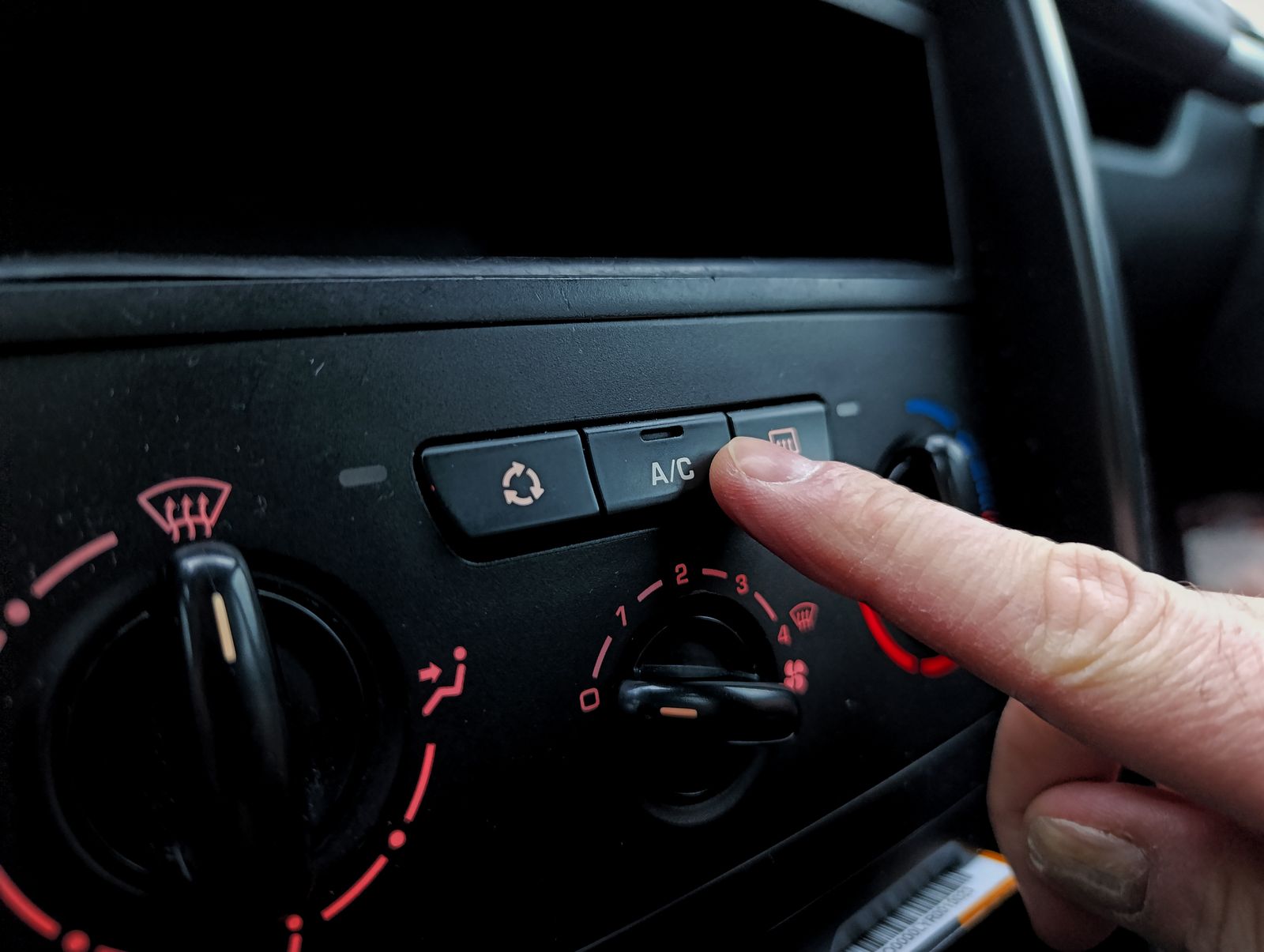
The fix takes 10 minutes and costs $10–$25:
- Pop the glove box (on most cars, the filter is behind it — YouTube your make/model).
- Pull out the old filter. If it's gray, brown, or has leaves stuck in it, it's overdue.
- Note the airflow arrow on the new filter — install it the same direction as the old one.
- Snap the glove box back in. Done.
Most cars want this every 15,000–20,000 miles, or every spring if you drive in dusty conditions. It's the single highest-ROI maintenance item on a modern vehicle, and the one most owners skip entirely.
How to Check Refrigerant: DIY Gauge vs. Shop Recharge
Once you've ruled out the cabin filter and your air is genuinely warm — not just weak — refrigerant is the next suspect. Here you've got two roads: the auto-parts-store DIY can, or the shop recharge with proper gauges.
The DIY Refill Can ($25–$50)
The cans at AutoZone or Walmart connect to your low-pressure service port (the one with the larger fitting on the suction-side line) and inject R-134a — or R-1234yf for most vehicles built after 2017. They include a simple gauge that reads OK / LOW / OVERCHARGED based on outside temperature.
This can work — temporarily — if your system is slightly low because of normal seepage. It is not a real diagnosis. Modern A/C systems hold about 1.5–2 pounds of refrigerant total. If you're adding a 12-ounce can every spring, you don't have a refrigerant problem. You have a leak.
Avoid the "stop leak" or "sealer" cans. They can gum up the orifice tube, contaminate the dye in the system, and turn a $200 hose replacement into a $1,200 compressor-and-condenser job. Plain refrigerant only, and only as a stopgap to get you to a shop.
The Shop Evacuate-and-Recharge ($150–$250)
A proper shop service uses a manifold gauge set to read both high-side and low-side pressures, pulls the entire system into vacuum to remove moisture, and weighs in the exact factory refrigerant charge. They can also inject UV dye to find leaks on a follow-up visit.
If you've never serviced your A/C and the car is more than 8–10 years old, this is the smarter starting point. You'll know whether you actually have a leak, where it is, and whether the system is just thirsty from age.
When a Freon Top-Off Is Just a Band-Aid
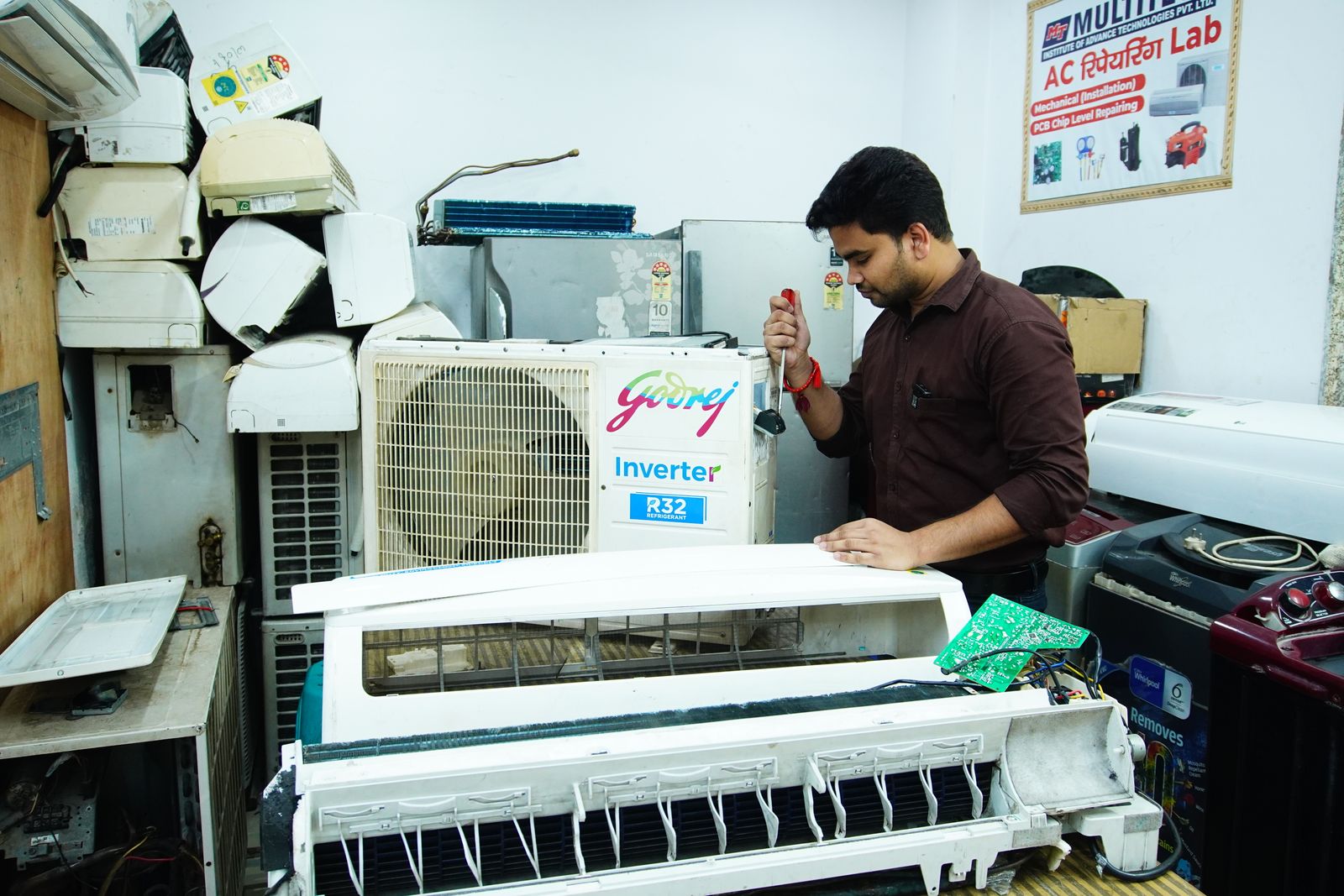
Here's the rule of thumb mechanics use: A/C systems should hold their charge for 5–10 years with no loss. A factory-spec system that needs a "top-off" every summer doesn't need refrigerant. It needs a leak repair.
Common leak points, cheapest to most expensive:
- Schrader valves on the service ports — $5 part, 10-minute fix.
- O-rings at hose connections — $20–$80 in parts, an hour of labor.
- Condenser (in front of your radiator, where rocks hit it) — $200–$500.
- Evaporator core (buried behind the dashboard) — $800–$1,500. This is the expensive one.
- Compressor seal or shaft — $600–$1,200 installed.
Letting a small leak run year after year forces the compressor to cycle on a low charge, which starves it of oil. Compressors don't fail from age — they fail from running low on lubricant because the system was undercharged. Fix the leak the first time and the compressor lasts the life of the car.

Parking Smart: How to Cut Heat Soak by 30+ Degrees
Half the A/C's job is undoing damage that happened before you turned the key. A car sitting in direct sun in a parking lot can hit 160°F on the dashboard and 130°F in the cabin in under an hour. Your A/C didn't suddenly get weak — you just asked it to fight an oven.

Easy wins, ranked by impact:
- Park in shade or a garage. The single biggest variable. A north-facing tree line beats every gadget on this list.
- Use a windshield sun shade. Drops cabin temperature 15–25 degrees on a sunny day. Reflective accordion-style shades work as well as the $40 fancy ones.
- Crack the windows ¼ inch. Lets the hottest air escape instead of cooking the dashboard.
- Drive with windows down for the first 60 seconds. Vent the superheated cabin air before you turn on the A/C. Your system cools fresh outside air far faster than it cools 130°F trapped air.
- Use "outside air" mode for the first minute, then switch to recirculate. Pushes the hot air out before you start cooling.
None of these cost anything, and together they take 30+ degrees off your starting cabin temperature. That's less time your A/C runs, less wear on the compressor, and less fuel burned to cool the car.
Other Summer Heat Risks Your A/C Can't Solve
While you're paying attention to climate control, don't forget that summer heat affects every system on the car. The biggest one drivers ignore: tire pressure. For every 10°F rise in pavement temperature, tire pressure rises about 1 PSI. A tire set to spec at 55°F in March can be 10 PSI overinflated by July afternoon — and an underinflated tire on hot asphalt is the #1 cause of summer blowouts.
Check pressures monthly during summer (cold, in the morning before driving), and don't trust the gas-station gauge. They're notoriously off by 3–5 PSI in either direction. A handheld digital gauge that reads in 0.5 PSI increments will pay for itself the first time it catches a slow leak before it becomes a roadside emergency. Same logic applies to the full road-trip prep checklist we covered earlier this month — a 10-minute inspection beats a tow-truck call every time. For dedicated tools, our tire pressure gauge collection covers everything from low-pressure off-road models to 100 PSI digital units.
What NOT to Do (The Mistakes That Turn $50 Problems into $1,200 Repairs)
- Don't use stop-leak refrigerant. Cheap fix, expensive aftermath. It can wreck your compressor, contaminate gauges at the shop, and turn a simple hose replacement into a system flush. Pay the $200 to find the actual leak.
- Don't keep adding refrigerant year after year. If you're refilling annually, you have a leak. Find it.
- Don't skip the cabin filter. A $15 filter you ignore for five years strains the blower motor and grows mold on the evaporator. That's a $400 blower and a $200 evap cleaning you didn't need.
- Don't run the A/C with a screeching compressor. The clutch bearing is failing. Driving it until it locks up usually destroys the compressor — and if it grenades, metal shavings can contaminate the entire system. That's the $1,500 job.
- Don't trust the auto-parts gauge as a real diagnosis. The OK/LOW reading on a recharge can is a rough estimate based on ambient temperature. It can't tell you whether your high-side pressure is dangerously high, whether your expansion valve is stuck, or whether your compressor clutch is cycling correctly.
- Don't ignore the smell. A musty vent smell is mold on the evaporator. Left alone for a season, it can become a health problem for anyone in the car with allergies or asthma.
The Summer A/C Health Check (10 Minutes, Once a Year)
Every spring, before the first heat wave, run this quick check:
- Start the car cold, set A/C to max cold, recirculate on, fan on high.
- Let it run 5 minutes. Use a kitchen thermometer in the center vent. Target: 35–45°F (about 35–40°F below outside ambient on a 75°F day).
- Walk around the car with the hood open. Listen at the front of the engine bay — A/C compressor clutch should engage with a soft click, no screeching.
- Check the cabin air filter (or just replace it preemptively if it's been more than a year).
- Look for oily residue around A/C fittings and the front of the condenser — that's refrigerant oil and a sign of a leak.
Five minutes of attention in May saves four-figure repair bills in August. The drivers who never have A/C problems aren't lucky — they just catch the small stuff before it becomes the expensive stuff.
Bottom Line
Your car's A/C is engineered for a decade of trouble-free cooling. When it underperforms, the cause is almost always one of three things: a clogged cabin filter (cheap), a slow leak that's been ignored too long (medium), or a compressor that ran on low refrigerant until it gave up (expensive). Catch it early and you'll spend less than a tank of gas. Wait until the air is hot and you're looking at a payment plan.
Park in the shade, replace the cabin filter every spring, get the system properly inspected if it's not holding charge, and stay on top of tire pressure once the pavement starts to bake. Do those four things and your summer drives stay cool — without the $1,200 surprise.