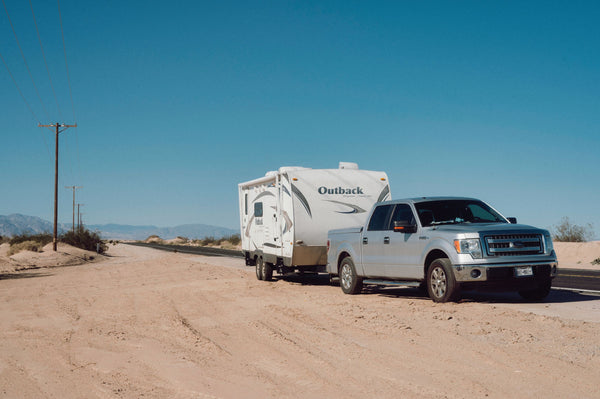


Hooking up a trailer for the first time is equal parts exciting and nerve-wracking. Whether you're hauling a camper to the lake, a pair of ATVs to the trailhead, or a load of furniture across town, towing changes how your vehicle stops, turns, and handles wind. The good news: towing is a skill, not a mystery. Get the fundamentals right and you'll feel confident before you reach the end of your street.
Here are 10 things nobody tells first-time towers — the details that separate a smooth trip from a white-knuckle one.
1. Know Your Numbers Before You Hook Up
Every tow vehicle has a maximum towing capacity, and it's almost always lower than people assume. Check your owner's manual and door-jamb sticker for your GVWR (Gross Vehicle Weight Rating) and GCWR (Gross Combined Weight Rating). Then weigh your loaded trailer.
Staying comfortably under your limits — not right at them — keeps your brakes, transmission, and drivetrain healthy. A rig loaded to 80% of capacity tows far better than one maxed out.
2. Match the Hitch and Ball to the Trailer
Trailer couplers come in specific sizes (typically 1-7/8", 2", or 2-5/16"), and your hitch ball must match exactly. A too-small ball can let the coupler pop off mid-drive — one of the most common and dangerous rookie mistakes.
Confirm the ball size stamped on your coupler, verify the hitch class is rated for your load, and always lock the coupler latch before you pull away.

3. Cross Your Safety Chains
Safety chains aren't optional — they're your last line of defense if the coupler fails. Cross them in an X pattern under the tongue so that if the trailer disconnects, the tongue lands in the "cradle" the chains form instead of digging into the pavement.
Leave just enough slack to allow full turns, but not so much that the chains drag.
4. Wire Up and Test Every Light
Before you leave the driveway, plug in the trailer's electrical connector and walk around with a helper. Test brake lights, turn signals, running lights, and reverse lights. Burned-out or disconnected trailer lights are a leading cause of getting pulled over — and a serious safety hazard at night.
5. Check Tire Pressure on Everything
Trailer tires and tow-vehicle tires both matter, and they're often overlooked. Underinflated trailer tires build heat fast at highway speeds — the number-one cause of trailer blowouts. Inflate every tire (including the spare) to the pressure listed on the sidewall or trailer placard, and check them cold before each trip.
A quick pressure check takes two minutes and can save you a shredded tire and a ruined weekend on the shoulder of the interstate.

6. Distribute Weight Correctly
Aim for roughly 60% of your cargo weight in the front half of the trailer, ahead of the axle. This creates proper tongue weight — generally 10–15% of the total trailer weight for a bumper-pull setup.
Too little tongue weight causes dangerous trailer sway; too much overloads the rear of your tow vehicle and lightens the steering. Load heavy items low and centered, then secure everything so nothing shifts in transit.
7. Strap Your Load Down Like You Mean It
A shifting load is a sway waiting to happen. Motorcycles, ATVs, mowers, and furniture all need to be tied to the trailer at multiple anchor points so they can't roll, slide, or bounce. Use quality ratchet straps rated well above the weight of what you're securing, and add soft loops to protect painted or chromed surfaces.
Recheck your straps after the first 10–15 minutes of driving — loads settle, and straps loosen as vibration works them in.

8. Adjust Your Mirrors and Driving Habits
You'll need to see past the width of your trailer, so add towing mirror extensions if your vehicle's mirrors don't reach. Then adjust how you drive: leave far more following distance, brake earlier and smoother, and take turns wider so the trailer's inside wheels clear curbs.
Everything happens slower with a trailer behind you. Patience is the whole game.
9. Master Backing Up in an Empty Lot First
Reversing a trailer feels backwards — because it is. The trailer turns opposite to your steering input. Before your trip, practice in an empty parking lot: place one hand at the bottom of the wheel and move it in the direction you want the trailer to go. Small inputs, slow speed, and a spotter make all the difference.
10. Watch for Sway — and Know How to Stop It
Trailer sway (fishtailing) can be triggered by crosswinds, passing semis, or downhill speed. If it starts, do not slam the brakes or jerk the wheel. Ease off the accelerator, keep the steering wheel straight, and gently apply the trailer brakes manually if you have a brake controller. Correct your weight distribution before the next leg.

Your First Tow, Done Right
Towing rewards preparation. Know your weight limits, match your hardware, secure your load, and check your tires — and that intimidating first trip becomes just another drive. Take it slow, double-check everything twice, and give yourself room to learn.
For more hauling and vehicle-prep guides, browse the Gravel & Gears Blog, and gear up with JACO's full lineup of tools and accessories built to keep you rolling wherever the road (or trail) ends.