
You just spent good money on a mountain bike with proper suspension — front fork, rear shock, maybe both. But if you haven't dialed in your suspension setup, you're leaving performance (and comfort) on the table. Factory settings are designed for an "average" rider that probably isn't you. The good news? Setting up your mountain bike suspension is straightforward once you understand a few key concepts, and it takes about 15 minutes with no special tools.

Why Suspension Setup Matters More Than You Think
Your suspension is the single biggest factor in how your bike handles terrain. Properly tuned suspension absorbs impacts efficiently, keeps your tires tracking the ground, and gives you confidence on rough trails. Poorly set up suspension? You'll bounce off obstacles, lose traction in corners, and fatigue faster because your body is doing the work your bike should handle.
Think of it this way: a $2,000 bike with perfectly tuned suspension will outperform a $5,000 bike with factory-default settings on every trail. Setup is free performance.
Understanding the Basics: Sag, Rebound, and Compression
Before you start turning dials, you need to understand three fundamental suspension concepts:
- Sag — How much your suspension compresses under your body weight alone (measured as a percentage of total travel). This is the most important setting and your starting point.
- Rebound — How quickly the suspension extends back after being compressed. Too fast and you'll get bucked off bumps. Too slow and the suspension "packs down" and can't absorb the next hit.
- Compression — How easily the suspension compresses when it hits something. Affects both small-bump sensitivity and big-hit absorption.
Most riders only need to set sag and rebound correctly to see a dramatic improvement. Compression tuning is more advanced and can wait until you've logged some trail time.
Step 1: Set Your Sag (The Foundation of Everything)
Sag is the percentage of travel your suspension uses just sitting on the bike in your normal riding position. Getting this right determines whether your suspension works in the correct range for your weight.
Target Sag Ranges
- Cross-country / trail riding: 25-30% sag
- All-mountain / enduro: 28-32% sag
- Downhill: 30-35% sag
How to Measure Sag
- Find your total travel. Check your fork and shock specs — it's usually printed on the stanchion or listed in the manual (common values: 120mm, 140mm, 150mm, 160mm for forks).
- Push the rubber o-ring (sag indicator) on the stanchion all the way down to the seal.
- Gear up in your normal riding kit — helmet, pack, water bottle, everything you'd carry on a ride. Weight matters here.
- Mount the bike carefully without bouncing. Have a friend hold you steady, or lean against a wall.
- Settle into your riding position — hands on grips, feet on pedals, looking forward. Let the suspension settle naturally.
- Carefully dismount without disturbing the o-ring.
- Measure the distance the o-ring moved from the seal. Divide by total travel to get your sag percentage.
Too much sag? Add air pressure in 5 PSI increments. Too little? Release air in 5 PSI increments. Repeat until you're in the target range.

Step 2: Dial In Your Rebound
Once sag is set, rebound is the next critical adjustment. The rebound knob is usually red and located at the bottom of your fork legs or on the bottom of your rear shock.
The Parking Lot Test
- Start with rebound fully closed (turned all the way clockwise / slow).
- Count the total clicks as you open it fully (counterclockwise). Note the total.
- Set it to the midpoint (e.g., if there are 20 clicks total, set it to 10 clicks from fully closed).
- Find a curb or small drop (6-8 inches). Roll off it at moderate speed.
- Too slow: The suspension feels sluggish, like riding through mud. The bike "packs down" and sits low after successive bumps. Open the rebound (turn counterclockwise) 2-3 clicks.
- Too fast: The bike bounces or kicks back after the drop. You feel like you're being launched. Close the rebound (turn clockwise) 2-3 clicks.
- Just right: The suspension returns smoothly and quickly, but doesn't bounce. The bike feels planted and ready for the next hit.
Fine-tune in 1-2 click increments from here. You want the fastest rebound that doesn't produce a "pogo" bounce.
Step 3: Compression Basics (Start Simple)
Many mid-range forks and shocks have a simple compression lever with 2-3 positions: open, medium (pedal), and locked. Here's when to use each:
- Open: Descending, rough terrain, technical trails. Full suspension performance.
- Medium / Pedal: Climbing and mixed terrain. Reduces pedal bob while maintaining some bump absorption.
- Locked: Smooth pavement or fire roads. Eliminates all suspension movement for maximum pedaling efficiency.
If your fork has a dial for low-speed compression (often blue), start at the midpoint. Increase (clockwise) if the bike feels too "divey" in corners or under braking. Decrease if the fork feels harsh on small bumps.
Rear Shock Setup: Same Concepts, Different Location
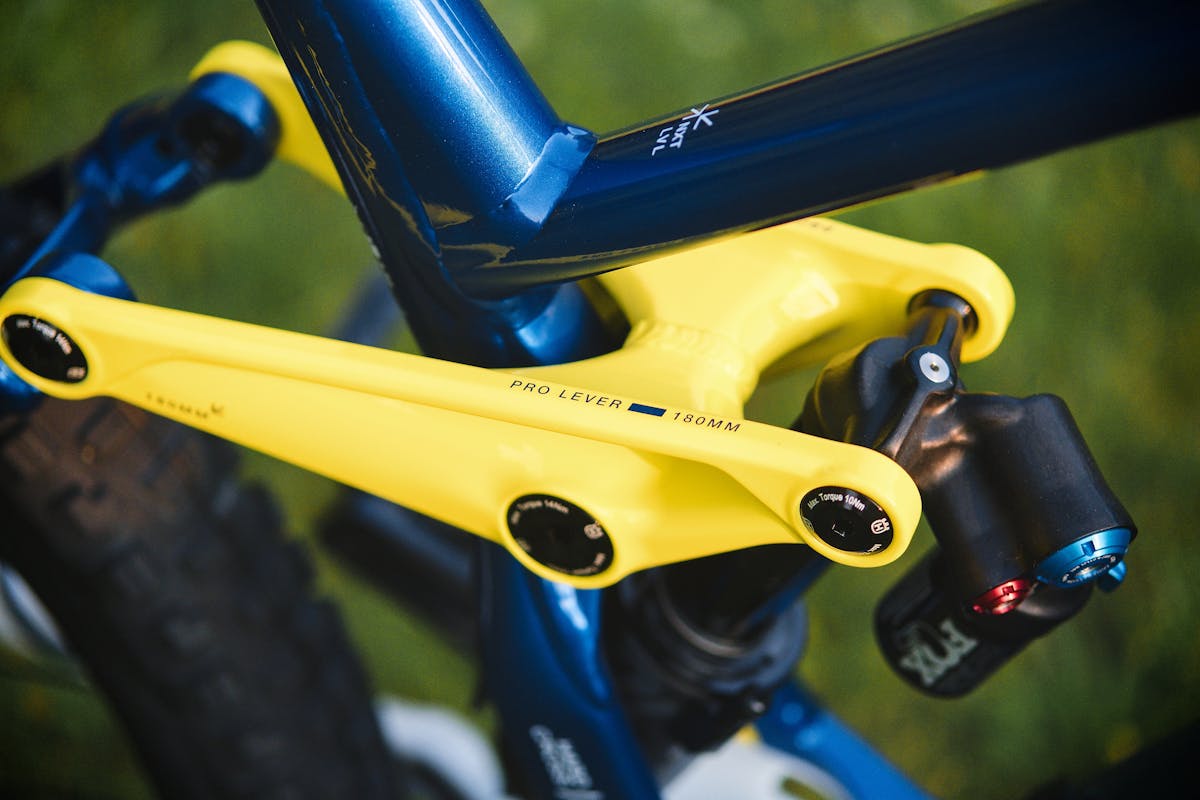
Everything you just learned for the fork applies to the rear shock with a few differences:
- Sag is measured differently. You're measuring shaft travel, not wheel travel. Use the o-ring method on the shock shaft itself. Metric shocks typically list stroke length (e.g., 55mm, 60mm, 65mm).
- Air pressure is usually higher. Rear shocks often need 150-250 PSI compared to 60-120 PSI for forks. Use a shock pump rated for higher pressures.
- Rebound affects pedaling. Too-fast rear rebound can cause the bike to buck under pedaling. Start slightly slower on the rear than the front.
A balanced setup means both ends of the bike sag roughly the same percentage. If you have 30% sag in the fork but only 20% in the rear, the bike will ride nose-low and handle poorly.
Essential Tools You'll Need
Suspension setup requires surprisingly little equipment:
- Shock pump: A standard floor pump won't work — you need a high-pressure, low-volume shock pump with a precise gauge. This is non-negotiable.
- Measuring tool: A ruler or zip-tie for measuring sag distance.
- Tire pressure gauge: While you're dialing in suspension, make sure your tire pressure is also set correctly — the two systems work together. A JACO BikePro Presta Tire Pressure Gauge gives you accurate, repeatable readings on mountain bike Presta valves, which matters more than you'd think when fine-tuning your overall ride feel.
- Hex keys: For any bolt adjustments (typically 4mm, 5mm, 6mm).

Common Mistakes to Avoid
After helping riders with suspension setup for years, these are the mistakes we see most often:
- Running too much air pressure. New riders tend to pump their suspension hard because "firm = fast." On the trail, you need the suspension to actually move. If you're only using 50% of your travel on aggressive rides, you're oversprung.
- Ignoring tire pressure. Your tires are your first line of suspension. Running 35 PSI on trails when you should be at 22-26 PSI negates everything your fork and shock are trying to do.
- Copying a friend's settings. Suspension setup is entirely weight-dependent. A 150-pound rider and a 200-pound rider on identical bikes need completely different air pressures.
- Never adjusting after the initial setup. As you improve as a rider and tackle different terrain, your suspension preferences will change. Revisit your setup every few months or when switching between trail types.
- Adjusting too many things at once. Change one setting at a time, ride, assess, then adjust the next. Otherwise you'll never know what made the difference.
Your First Ride: What to Pay Attention To
After dialing in your setup at home, head to a trail you know well. Pay attention to:
- Bottom-out: Are you using all your travel on big hits? If you bottom out frequently, add 5-10 PSI. Occasional bottom-out on the biggest hits is fine — that means you're using your full travel range.
- Small bump sensitivity: Can you feel the trail surface, or does the bike skip over smaller bumps? If it feels harsh, reduce compression or slightly lower air pressure.
- Cornering: Does the fork dive excessively under braking into corners? Increase low-speed compression. Does the rear feel loose or "wallowy"? Check rear sag and rebound.
- Climbing: Excessive pedal bob on climbs? Use your compression lever's pedal position, or increase low-speed compression slightly.
Take mental notes and make one adjustment at a time between runs. Within a few rides, you'll find a setup that makes your bike feel like an extension of your body — and you'll wonder how you ever rode on factory settings.
Get Out and Ride
Suspension setup isn't rocket science, but it is one of those things that separates riders who love their bikes from riders who think they need a new one. Spend 15 minutes with a shock pump and this guide, then go ride. Your trails will feel different. Your confidence will be higher. And your bike? It'll finally be working the way it was designed to.