

Every year, an estimated 4,800 people end up in the emergency room because of crushing injuries from vehicles that fell off a jack. The math is brutal: a small hydraulic seal failure, a soft patch of asphalt, or a single shortcut can drop a 4,000-pound car onto whoever's underneath it. The good news is that the rules for working safely under a lifted vehicle are simple, repeatable, and forgiving — once you actually follow them.
Whether you're rotating tires, swapping brake pads, doing an oil change, or chasing an exhaust rattle, this guide walks through how to use a floor jack and jack stands the right way at home. No shop tricks, no "trust me, it'll hold" — just the rules that keep your face attached to your skull.
The One Rule That Matters Most
Before anything else, internalize this: a floor jack is for lifting, never for holding. Hydraulic jacks rely on a small seal and a column of fluid to keep your car in the air. Seals fail. Fluid leaks. Pressure releases. The jack handle gets bumped. None of those things are catastrophic if jack stands are doing the actual holding — they're a death sentence if a hydraulic jack is the only thing between you and the floor.
Lift with a jack. Support with stands. Lower the car onto the stands and confirm it's settled before any part of your body goes underneath. There is no exception to this rule.
Choose the Right Jack and Stands for Your Vehicle
Tonnage ratings tell you the maximum weight a jack or stand can support. The trick is that ratings are for the full vehicle, not the corner you're lifting. A 2-ton jack does not safely lift a 4,000-pound truck just because you're only lifting one wheel — you want a comfortable margin.
A reasonable rule of thumb:
- Compact cars and sedans (under 4,000 lb): 2-ton jack and 2-ton stands minimum. 3-ton is safer.
- SUVs, crossovers, midsize trucks (4,000–6,000 lb): 3-ton jack and 3-ton stands.
- Full-size trucks, ¾- and 1-ton pickups, vans (6,000–9,000 lb): 3.5- to 4-ton jack and 6-ton stands.
Buy stands in pairs that match (or exceed) the jack rating. Look for stands with a wide base, a ratcheting locking pin (or a flip-style locking pawl), and a saddle that grips the frame — not a smooth flat top that wants to slip.
Find the Right Jack Points (Not Just Anywhere Under the Car)
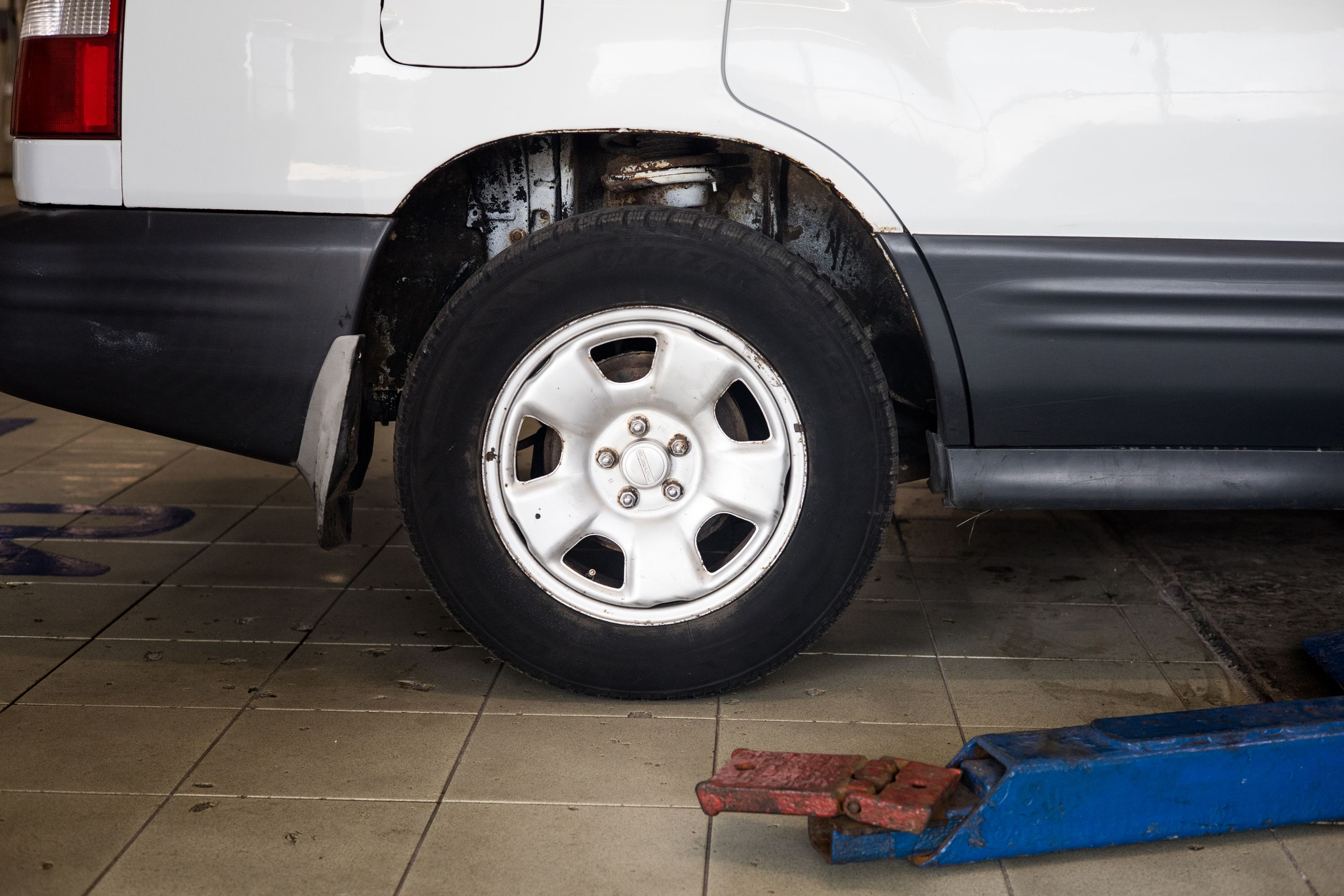
Modern cars are not solid steel boxes. Most are unibody construction, which means the floor pan is thin sheet metal designed to crumple in a crash, not to hold the weight of the entire vehicle. Lift in the wrong spot and you'll punch the jack saddle through the floor — or bend a pinch weld so badly the door won't close right.
Always reference the owner's manual for factory-designated jack points. They usually fall into a few categories:
- Pinch welds — a reinforced seam along the rocker panel, just inboard of the door sill. Most unibody cars use these. Use a slotted pinch-weld adapter (a rubber or polyurethane puck with a groove) to avoid crushing the seam.
- Subframe and crossmember — a solid steel structural member, usually near the front and rear of the vehicle. Heavier and forgiving. Most trucks and body-on-frame SUVs lift here.
- Differential housing or axle tube — common rear lift point for trucks and solid-axle vehicles. Spreads load across both rear wheels.
- Control arm pickup points — used when you specifically need the suspension loaded (e.g., torquing control arm bolts at ride height).
Never lift on the oil pan, transmission pan, plastic body cladding, exhaust, steering rack, or sway bar. They will deform or crack, and the cost of one mistake is usually higher than the cost of a proper jack pad.
Pick a Surface That Won't Move
The ground under the jack is half the safety equation. Concrete that's level, dry, and free of cracks is ideal. What to avoid:
- Asphalt in summer heat — soft asphalt lets jack wheels and stand bases sink unevenly, especially under a heavy truck. If asphalt is your only option, place a wide piece of plywood or steel plate (¾" minimum) under the jack and stands to spread the load.
- Sloped driveways — even a 2° slope changes the geometry of how a jack rolls as it lifts. The car wants to slide downhill toward the jack. Park on the flattest section you can find, chock the wheels still on the ground, and lift uphill side first.
- Gravel or dirt — never. Find a different spot or use steel plates large enough to fully support the stand base.
- Loose floor mats, towels, or cardboard — they look like padding and act like a banana peel. Move them.
Chock the Wheels — Every Time
Wheel chocks cost less than $15 and have prevented more garage accidents than every other piece of safety gear combined. Before you lift:
- Park on a flat, hard surface and put the transmission in Park (automatic) or 1st gear / reverse (manual).
- Set the parking brake firmly.
- Chock both sides of the wheel(s) that will stay on the ground. If you're lifting the front, chock the rear wheels front and back.
The parking brake only locks the rear wheels on most vehicles. If you're lifting the rear, the parking brake is essentially useless — chocks become the only thing keeping the car from rolling.
The Lift Sequence: Slow, Smooth, Settled
Here's the actual sequence, start to finish:
- Position the jack directly under the designated jack point. Confirm the saddle is fully seated against the lift point with no gap.
- Pump slowly. Watch the jack and the lift point as the car rises. If anything looks off — saddle slipping, metal flexing in a strange way, the car shifting sideways — lower it and reposition.
- Lift just high enough to slide the jack stand into position with a small gap, not the full height of the stand.
- Set the stand at a structural point near the jack point. The saddle of the stand should grip the frame, pinch weld, or subframe — not the body sheet metal.
- Lower the jack slowly until the car settles onto the stand and the stand takes the weight. The jack should still be in place but no longer load-bearing.
- Test before crawling under. Push the car laterally with both hands. It should feel rock solid. If it rocks, wobbles, or shifts, stop — re-seat the stand or pick a different lift point.
Leave the jack in place as a secondary backup. It's not your primary support, but if a stand fails, that extra few inches of steel can save your chest from a 4,000-pound piano.

Things to Never Do
The accidents that kill DIYers almost always involve one of these:
- Working under a car held only by a hydraulic jack. Even for "just a second." Even for an oil change. Use stands.
- Stacking blocks of wood, bricks, or cinder blocks as makeshift stands. Cinder blocks have crushing strength when loaded vertically and zero tolerance for any shear or shifting load. They explode without warning.
- Lifting on a slope without chocks.
- Skipping the lateral push test before sliding underneath.
- Trusting bumper jacks (the scissor jack in your trunk) for any work beyond a roadside flat tire swap. They're emergency tools, not garage tools.
- Pulling on the jack handle hard while you're still under the car. If you need to lower it, get out first.
- Working alone on a major job with no one home. If something goes wrong, your phone needs to be in arm's reach and someone needs to know you're under there.
After the Job: Reseating, Lowering, and Final Checks
When you're ready to drop the car back down:
- Re-engage the floor jack and lift slightly to take weight off the stands.
- Remove the stands one at a time, away from your hands.
- Lower the jack slowly and smoothly — no jerks, no fast releases. A controlled lower keeps suspension components and wheels from slamming down.
- Re-torque any wheels you removed. Hand-tight is not torque spec. Use a torque wrench and the value listed in the owner's manual (typically 80–100 lb-ft for passenger cars, 130–150 lb-ft for ½-ton trucks).
- Re-check tire pressure on every wheel before driving. Pressure drops when wheels are off the ground, and the safest move is to verify all four are at spec before pulling out of the garage.


Build a Lift-Day Kit and Use It Every Time
The fastest way to make safe work routine is to keep everything you need in one place. A simple "lift day" kit:
- A 3-ton low-profile floor jack rated for your vehicle
- Two (or four) matching jack stands
- A pair of solid wheel chocks
- A pinch-weld adapter or hockey-puck jack pad
- A torque wrench in the right range for your lug nuts
- A tire pressure gauge for the post-job check
- A piece of plywood or steel plate for soft surfaces
For more on dialing in tire pressure after wheel work — including why tire-shop "30 PSI on everything" is rarely correct — see our guide to how to safely change a flat tire on the side of the road. And if you're outfitting a home garage from scratch, our full JACO product collection covers the inflation, gauge, and air hose side of the build.
Bottom Line
Lifting a car at home isn't dangerous because gravity is unforgiving — it's dangerous because shortcuts are tempting. Use a jack rated for your vehicle. Lift on a designated jack point on a flat, hard surface. Chock the wheels. Set jack stands and let them carry the weight. Test before you slide under. Every time, no exceptions, no "this once."
The job in front of you will still be there in five extra minutes. Spend them on the safety setup. Future-you, the one with all their fingers and a working spine, will say thanks.