

It happens to everyone who spends enough time off the pavement: one wrong line, one soft patch of sand, one greasy mud rut, and your rig stops moving. Now imagine it's just you. No buddy truck idling behind you, no winch on the bumper, and no cell signal to call for help. That sinking feeling is real—but getting stuck alone doesn't have to mean spending the night in the backcountry.
Solo vehicle self-recovery is a skill, not a stroke of luck. With the right approach and a few pieces of gear you probably already own, you can get most vehicles unstuck without a second rig, a winch, or a tow truck. Here's how to stay calm, work the problem, and drive away under your own power.
First: Stop and Assess Before You Make It Worse
The single biggest mistake solo drivers make is mashing the throttle the moment the tires slow down. Spinning wheels dig you deeper, superheat the ground under your tires into a slick glaze, and can bury an axle in seconds. The moment you feel the vehicle bog, get off the gas.
Then get out and look. Walk a full lap around the vehicle and answer three questions:
- What's stuck? Are all four tires spinning, or is one wheel hanging in the air (a classic on uneven terrain)?
- What's under you? Mud, dry sand, loose gravel, or snow each call for a slightly different fix.
- Which way is easiest out? Reversing back down the tracks you already packed is almost always easier than pushing forward into fresh, unbroken ground.
Clear your recovery plan in your head before you touch the pedals again. Two minutes of assessment saves an hour of digging.
Air Down Your Tires for Instant Traction
If you take one thing away from this article, make it this: lowering your tire pressure is the fastest, cheapest, most effective self-recovery trick there is. Dropping from a street pressure of ~35 PSI down to 15–20 PSI (or even lower in deep sand) flattens the tire's contact patch, letting it float over soft surfaces and claw for grip instead of cutting down into them.
In sand and snow especially, airing down alone will free a huge percentage of stuck vehicles with zero digging. The catch is doing it quickly and evenly—fumbling with a valve cap and a cheap pencil gauge while you're bogged is miserable. A dedicated rapid deflator lets you dump air on all four tires to an exact pressure in under a minute.

Clear the Path: Dig and Remove Obstacles

If airing down isn't enough, your next free tool is a shovel and some elbow grease. The goal is simple: give the tires a gentle ramp to climb instead of a wall to fight.
- Dig out in front of (or behind) each tire in the direction you want to travel, sloping the ground gradually up to tire level.
- Clear high-centered obstacles. If your frame or diff is resting on a rock, dirt mound, or packed snow, the tires can't get weight on them. Remove what's holding you up.
- Knock down the berm of mud or sand that piled up ahead of the tires while they spun.
A compact folding shovel lives easily behind a seat and is worth its weight in gold out here. Work slowly—you don't want to be exhausted and sweat-soaked before the real attempt.
Build Traction Under the Tires
Now give those tires something solid to bite. Purpose-built traction boards (recovery tracks) are the gold standard—you wedge them under the drive tires in the direction of travel and slowly drive up and out. But if you don't carry them, improvise with what the environment gives you:
- Floor mats from your vehicle, textured side up.
- Branches, brush, and flat rocks packed into the rut ahead of the tires.
- A hi-lift jack to lift a buried wheel and backfill solid material underneath it.
Whatever you use, seat it firmly against the tire so there's no gap for the wheel to spin before it grabs. Then apply throttle gently—the enemy is always wheelspin.
The Rocking Technique

When you're bogged in a hole, rocking builds momentum by using the vehicle's own weight. On an automatic, shift smoothly between Drive and Reverse, giving light throttle each direction to swing the vehicle a little farther out of the rut with each cycle. On a manual, ease the clutch to nudge forward, let it roll back, then nudge again.
Timing matters more than power. As the vehicle rocks back on its own, meet it with gentle throttle in the opposite direction to extend the swing. A few patient cycles can walk you right out of a hole that full throttle would only dig deeper. Just don't abuse the transmission—if you smell anything hot or the rocking isn't gaining ground after several tries, stop and go back to digging and traction.
Air Back Up Before You Drive Off
Once you're free, you're only half done. Driving any real distance on 15 PSI tires risks overheating the sidewalls, rolling a tire off the bead on a hard turn, or damaging the wheel. Before you get back up to speed—especially if you're heading toward pavement—air your tires back to their proper on-road pressure.
A portable compressor is the piece that closes the loop on the whole air-down strategy, and going cordless means you're never tethered to the engine bay or a dying cigarette-lighter socket while you work.

When You Do Have a Winch (or a Sturdy Anchor)
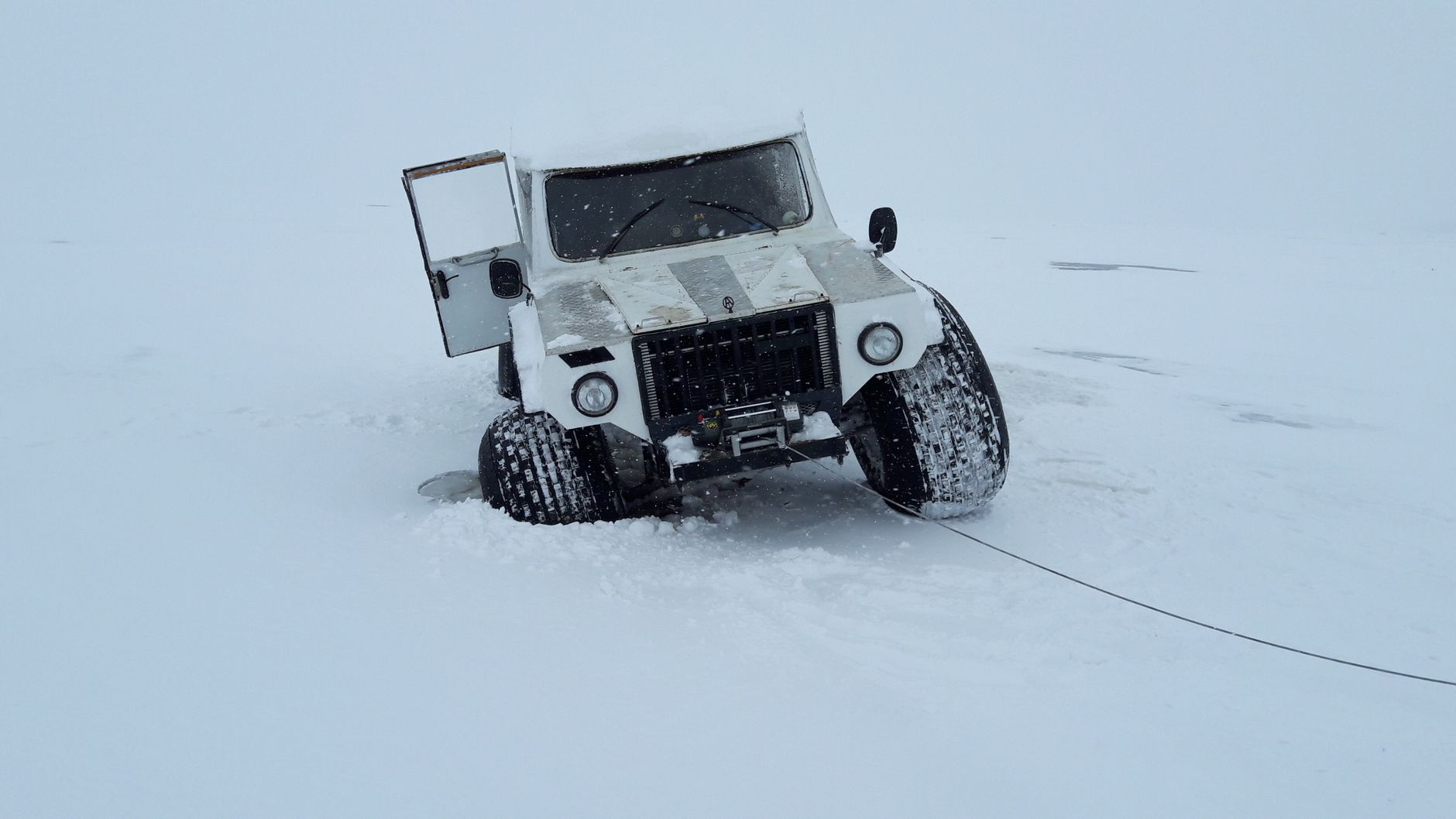
If your rig is equipped with a winch, solo recovery gets a lot easier—but it still demands respect. Anchor to a healthy tree (use a wide tree-saver strap, never bare cable), a large boulder, or a buried spare tire as a "deadman" anchor in open ground. Lay a recovery damper or even a heavy jacket over the tensioned line to absorb energy if something lets go, keep bystanders and yourself out of the line's path, and winch in short, controlled pulls.
No winch? A come-along hand winch and a couple of quality recovery straps can accomplish the same thing with more sweat and patience. The principles are identical: solid anchor, protected line, controlled tension.
Build a Solo-Ready Recovery Kit
Self-recovery is mostly about carrying the right small stuff before you need it. A minimalist solo kit fits in a duffel and covers the vast majority of situations:
- Rapid tire deflator and an accurate pressure gauge
- Portable air compressor to re-inflate
- Compact folding shovel
- A pair of traction boards
- Recovery straps and rated soft shackles
- Work gloves, a headlamp, and drinking water
Add a basic tire repair and plug kit and you can handle punctures too. For more on dialing in pressures on the trail, our guide to airing down for trail riding pairs perfectly with everything above, and you can browse JACO's full lineup of off-road air tools and gauges to round out your kit.
The Bottom Line
Getting stuck alone is stressful, but it's rarely an emergency if you stay methodical. Stop spinning, assess the situation, air down for traction, dig a clean path, build grip under the tires, and rock your way out—then air back up before you drive home. Master those steps and carry a compact recovery kit, and "stuck out here by myself" turns into a story you tell later instead of a night you'll never forget. Air down, dig smart, drive out.